




























Writer-director Osgood Perkins respects and fears young women as vessels for great and terrible power. For a horror filmmaker, that’s a strong start toward a memorable story. Perkins’ debut feature, The Blackcoat’s Daughter, cast Mad Men’s Kiernan Shipka as a serial murderer attempting to summon a demon out of the boiler room at her Catholic girls’ school. His well-feted 2016 follow-up, I Am the Pretty Thing That Lives in the House, trapped a nurse played by Ruth Wilson in a stately Massachusetts mansion, and then in the ages-old Gothic ghost story playing out there.
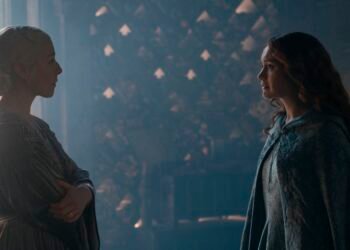
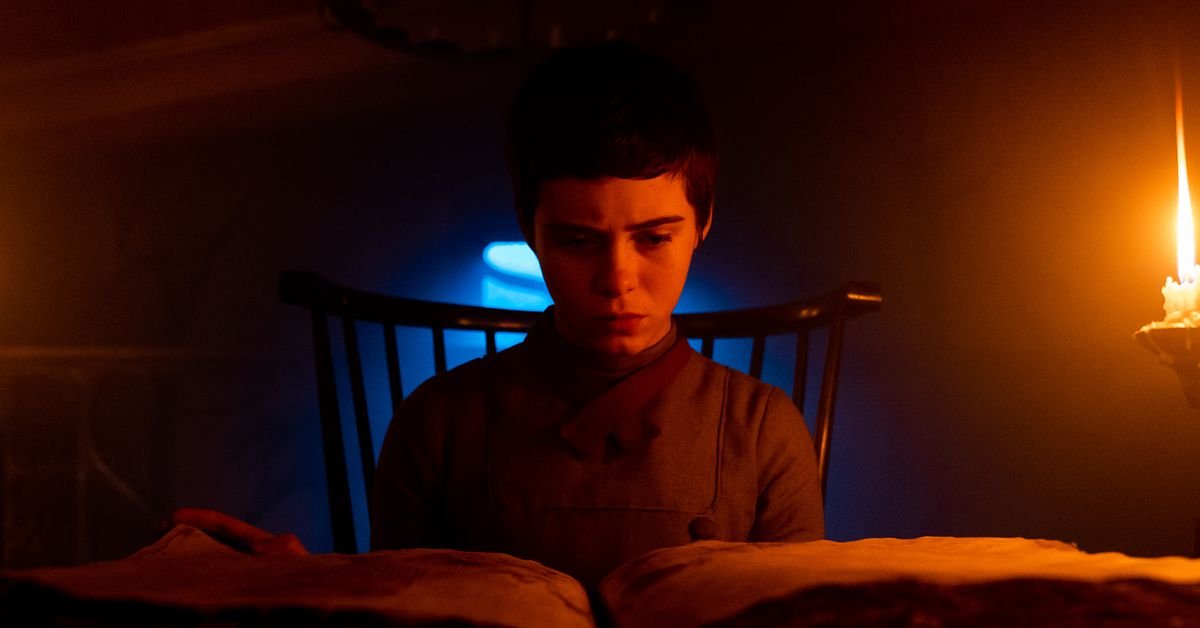
With his third film, Gretel & Hansel, Perkins moves his preoccupation with budding femininity — the blood, the chaos, the revelatory intensity — from the subtext to the surface. As the retitling suggests, Gretel (Sophia Lillis, of It fame) claims center stage in this revisionist take on the Brothers Grimm fairy tale. Her brother Hansel (Sammy Leakey) is only 8, but she’s 16, and taking her first tentative steps into womanhood. That process coincides with the arrival of the fable’s third integral component, the Witch (a phenomenal Alice Krige), who clearly has nefarious plans for the youngsters. But her motivations go beyond simple hunger for boy-flesh, and likewise, her conflict with Gretel falls along much blurrier lines than the ones the Grimms laid out.
All is not as it seems, not just in the Witch’s severely triangular cabin, but also in nationwide multiplexes, where what might appear to be a scrap of January’s usual cinematic chaff conceals a finely honed visual sensibility and a complex set of ideas. Perkins makes scary movies of uncommon ambition and sophistication, juggling multitiered chronology with a literary pedigree and a rigorously controlled aesthetic, and yet he never seems to be part of the conversations about exciting new auteurs that regularly include Ari Aster, Jordan Peele, and Robert Eggers. Gretel & Hansel could change that.
:format(webp):no_upscale()/cdn.vox-cdn.com/uploads/chorus_asset/file/19662026/gretel_hansel_Sophia_Lillis_and_Sammy_Leakey_star_in_GRETEL_HANSEL_rgb.jpg)
Photo: Patrick Redmond/Orion Pictures
From the earliest scenes, which find Gretel and Hansel fleeing their mother in search of food, Perkins announces his distinctive directorial style. He’s replaced plucked strings — the usual choice for the once-upon-a-time school of yarn-spinning — with a sinister synth score. His woodland scenery exudes an ambient menace, due both to otherworldly lighting through the stark trees, and fisheye photography warping the borders of reality.
Disciples of midnight-movie maestro Panos Cosmatos (who charted new frontiers of psychedelia with Beyond the Black Rainbow and Mandy) will be tipped off by the ’70s font and kaleidoscopic design of Gretel & Hansel’s title card. Cinematographer Galo Olivares, last seen serving as Alfonso Cuarón’s camera operator on Roma, assembles geometric wide shots that lend their accentuated circles, triangles, and squares the eerie quality of occult totems. It’s hard to tell whether it’s all an ominous shade of surreal, or a surreal shade of ominous, and that’s before the kids unwittingly ingest psilocybin mushrooms.
Part of the story is business as usual: The kids bust into the Witch’s house, gorge themselves on delicacies, and get in over their heads. But the wiggle room Perkins loosens up for himself within the well-known template sets a model example for other storytellers looking for ways to refresh hidebound myths. Perkins sees the Witch, Gretel, and Hansel as a set of malleable signifiers he can invest with the deeper meaning of his choosing. In this case, that turns out to be the friction between feminism’s second and third waves. It’s an unlikely choice for a horror allegory, but if Dario Argento can spin Suspiria out of a commentary on the violent transfer of power in reconstruction-era Germany, anything goes.
Though a generation separates them, the Witch recognizes Gretel as a kindred host for the overwhelming energies that gave the Witch her power — and got her vilified by a society that didn’t understand or trust her. In just-right cryptic language — not so explicit as to demystify the atmosphere, yet not so abstract as to sound like gobbledygook — she informs her teenage guest that a primal potential lies inside her, waiting to be unlocked. Gretel just needs to reject public life and embrace her own innate strength, starting by removing her brother, the albatross around her neck. The one point the Witch makes clear is the absolute incompatibility of the male gender with their weltanschauung. In her view, men and boys are strictly for fattening up and devouring. (She sounds like Valerie Solanas in a pointy hat.) Gretel finds these ideas compelling, but she’s looking for a less absolute worldview that won’t treat her love like weakness.
:format(webp):no_upscale()/cdn.vox-cdn.com/uploads/chorus_asset/file/19662034/gretel_hansel_Alice_Krige_stars_in_GRETEL_HANSEL_rgb.jpg)
Photo: Patrick Redmond/Orion Pictures
Perkins doesn’t get too bogged down in the finer points of these competing theories. He hustles through his film’s fleet 87 minutes on his way to a grand finale that compresses all its pleasures into one scene. Bracingly unanticipated, strikingly composed, and symbolically loaded, this set-piece demonstrates Perkins’ adeptness as both a formal stylist and a dark bard. It’s the sort of calling-card sequence a guy can show off to studios when he’s shopping his next feature around and hoping to scale up. The inkling that we’re watching a true talent in the early phases of an illustrious career may be the most thrilling aspect of a film that’s by no means short on thrills of its own.
While the svelte runtime and all the explanatory voice-over hints at possible nudges from studio higher-ups, Gretel & Hansel has still been shaped by a clear authorial voice. The subtle fusion of olden and modern notions of the mystical, part picture book and part Alejandro Jodorowsky, announces itself as a unique vision. The shameful secret of movie critics is that the comparatively lean pickings of the early-winter season can make us overly appreciative of something this distinct and thought through. So in the interest of tamping down hyperbole, suffice to say: If Gretel & Hansel doesn’t turn out to be one of the year’s genre highlights, 2020 will be a very good year at the movies indeed.
Gretel & Hansel is in theaters now.